Skip the Launch-Day Line: The $2,000 Used Cinema Kit That Outshoots New Mirrorless Bodies
Every fall the camera industry does its thing, and every fall a bunch of indie filmmakers do the math and realize the math does not work. A new full-frame hybrid with one decent zoom lands somewhere between $2,500 and $3,500 before you have bought a card, a spare battery, or anything that records sound. Meanwhile the used market is quietly flooded with cinema cameras that shot real festivals, real commercials, and real features — and they are priced like a decent used sedan's down payment.
So here is the argument, laid out in dollars: in 2026, roughly $2,000 spent on used gear and one smart software purchase will out-deliver a $2,000 new camera body for narrative and documentary work headed to 1080p or 4K delivery. Not in every category — autofocus, stills, and pocketability still belong to the new stuff. But indie films rarely die because the sensor was two generations old. They die because the audio was garbage, the shot was shaky, the operator could not see focus, or the card filled up at the worst possible moment.
The bodies nobody is fighting over
The Blackmagic Pocket Cinema Camera 4K arrived in 2018 at $1,295 with a Micro Four Thirds mount, 10-bit 4:2:2 ProRes, and Blackmagic RAW. Eight years later it trades around $550–$700 used, and it still writes files that are easier to grade than what most $2,000 hybrids hand you out of the box. Dual native ISO, a real headphone jack, full-size HDMI, and USB-C recording to an external SSD are not retro charms — they are workflow features people pay new-camera money for.
The Canon C100 Mark II is the other sweet spot at roughly $750–$900. It is 1080p only, full stop. It also has dual XLR inputs, built-in ND, a top handle with a mic mount, and a battery that lasts an entire shooting day. If your delivery target is a 1080p master and a festival DCP, that package is not a compromise — it is the shortest path to finishing.
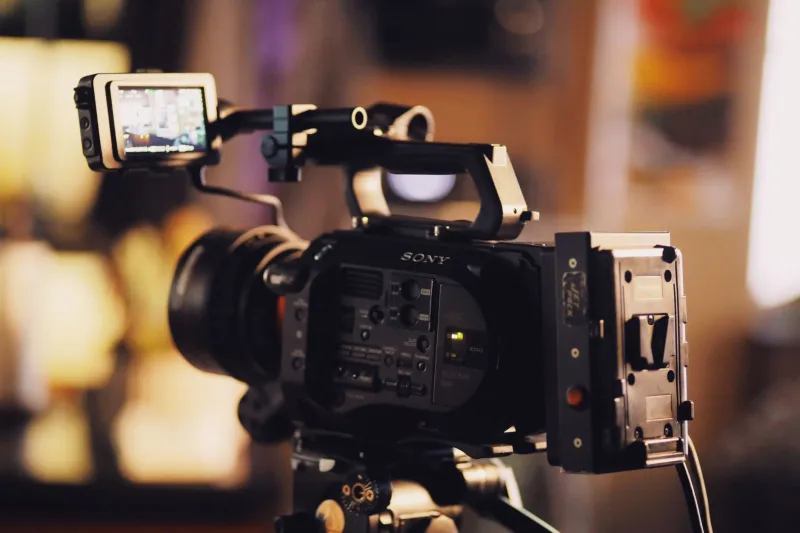
Also worth a look: the Sony FS5 around $900–$1,100 for its variable ND and light body, and the Panasonic GH5S near $600 if you want MFT glass and excellent low light. None of these will impress anyone at a gear meetup. All of them will get a short film in the can.
One caveat, and it matters: used means no warranty. Budget for a sensor inspection, ask for shutter or hour counts where applicable, check the mount for wear, and buy from a seller with a return window.
A real $2,000 build, line by line
| Slot | Pick | Typical used price |
|---|---|---|
| Body | Blackmagic Pocket 4K | $550 |
| Glass | Sigma 18-35mm f/1.8 EF + Viltrox EF-M2 adapter | $400 |
| Support | Manfrotto 502 head on aluminum sticks | $180 |
| Audio | Deity S-Mic 2 + used Zoom H5 | $300 |
| Monitoring | Feelworld F6 Plus 5.5-inch | $130 |
| Media & power | 1TB USB-C SSD, two spare batteries, cage | $140 |
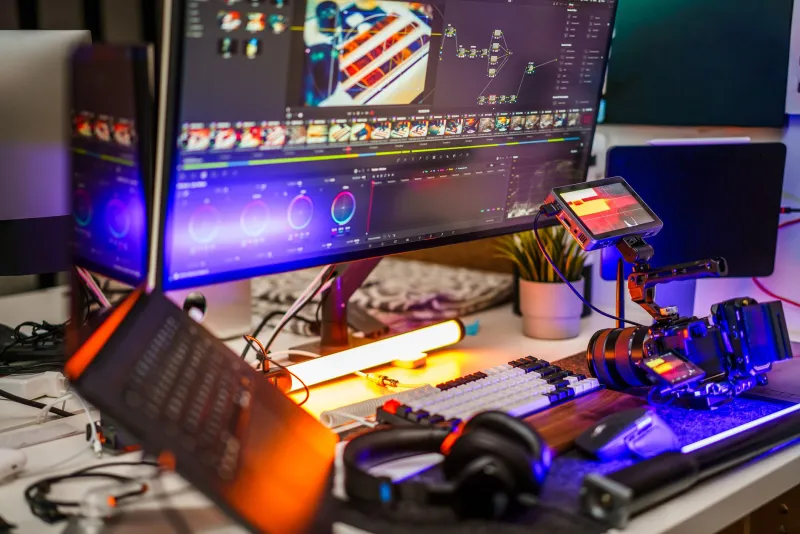
| Software | DaVinci Resolve Studio (one-time license) | $295 |
| Total | $1,995 |
That column is the whole point. A new body at $2,000 gets you a body. This list gets you a camera, a fast zoom, a tripod that does not drift mid-take, a shotgun mic with a decent preamp behind it, a monitor you can actually focus on, and a grading suite that will not send you a bill every month.
Skip the gimbal, buy a light
The single most common budget mistake is reserving $400 for a stabilizer and $0 for lighting. A used LED panel with a softbox and a couple of diffusion rags runs $150–$250 and does more for perceived production value than any movement device. A camera on sticks, lit with intent, reads as a film. A camera drifting through an unlit living room reads as a phone video with extra steps.
Wringing a 2018 sensor dry in 2026
The workflow is where the savings actually turn into pictures.
- Shoot 4K, finish 1080p when you can. Downsampling 4K DCI to a 1080p timeline buys you cleaner detail and less visible noise than shooting 1080p natively. For most indie deliverables it is free quality.
- Use constant bitrate RAW for the shots that matter. On Blackmagic bodies, 3:1 on hero shots and 8:1 on coverage keeps cards honest without wrecking your grade.
- Lean on dual native ISO. Instead of pushing a slow lens wide open, light to the second native ISO and stop down. You will spend less on glass and get a cleaner negative.
- Grade with restraint. Older sensors have less highlight headroom than current ones, so protect the top end on set and keep the contrast curve gentle. A light film-emulation LUT plus a qualifier or two beats a heavy node tree.
- Sharpen last, on the GPU. Resolve's noise reduction and sharpening are dramatically faster than they were a few years back, but they still want VRAM. A $250 used graphics card is a better upgrade than a new lens here.
Where the new mirrorless still wins
Be honest about the trade. If you shoot run-and-gun events, solo weddings, or anything with moving subjects and no focus puller, modern subject-detection autofocus is worth real money. If you also shoot stills, need IBIS for handheld work, or want a body that fits in a sling bag, the hybrid is the rational buy. And if you need a warranty because a shoot cannot slip, that has a price too.
But if your work is planned, lit, and edited — narrative shorts, music videos, interviews, branded docs — the used cinema kit is the better allocation of two thousand dollars in 2026. You are buying a system instead of a sensor.
The bottom line
Cameras got good enough a long time ago. What separates a finished short from a folder of test footage is not the body's spec sheet; it is whether you could hear the dialogue, hold the frame steady, see focus, and grade the thing without a fight. Two grand, spent carefully on the used market and one perpetual software license, buys all four.