Three $300 Lighting Kits That Beat a Single Softbox (and Where They Don't)
A single softbox is the vanilla ice cream of indie lighting. It is reliable, affordable, and hard to hate. It is also one light with one personality. In 2026, entry-level softbox kits still land around $100 to $180, which makes them the default first purchase. But for a little more planning, you can build a kit that gives you control a single box cannot.
We compared three sub-$300 setups against a baseline 24x36-inch softbox with an 85W bi-color LED. The goal was not to trash the softbox. The goal was to find the shots where a small, specific kit clearly wins, and the shots where the softbox still makes more sense. Prices below are street prices and will move with sales, but the parts are common in US camera stores and online.
The baseline: one softbox, one look
The softbox does one thing well: it wraps a subject in soft light. For a single talking head, that is often enough. Put it at 45 degrees, add a reflector for fill, and you have a clean interview look. The problem shows up when you need separation, shape, or a second angle. One softbox gives you one source. You can flag it, diffuse it, or move it, but you cannot make it into two lights without buying more gear.
Kit 1: The two-panel interview kit
Approximate cost: $250
- 2x Neewer 660 PRO bi-color LED panels: about $90 each
- 2x light stands: about $25 each
- 1x 5-in-1 reflector: about $20
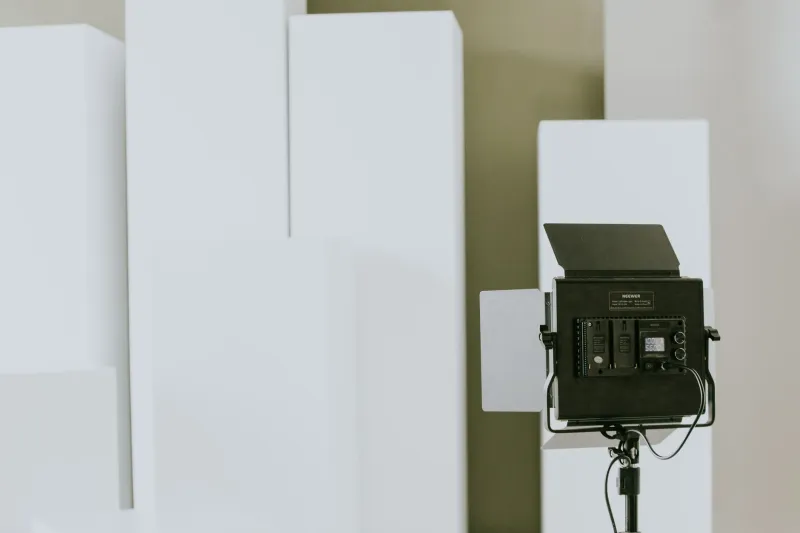
This is the practical interview kit. Put one panel at 45 degrees as the key, use the second panel as a fill or a background light, and keep the reflector for a little bounce under the eyes. The panels are not cinema-grade fixtures, but they are bi-color, dimmable, and easy to power in a living room. Two sources mean you can light a two-person interview without one person falling into shadow. You can also throw a colored gel on the background light for a little separation.
Against the single softbox, this kit wins for fast corporate interviews, two-person setups, and any room where you need a background accent. The softbox still wins for a single-subject beauty look with one clean, wrapping source. If your interview has one person and one camera, the softbox is simpler. If it has two people or a branded backdrop, the two-panel kit is the better buy.
Kit 2: The hard-light narrative kit
Approximate cost: $280
- 1x used 650W tungsten fresnel: about $100
- 1x used 300W tungsten fresnel: about $60
- 2x stands: about $60
- 1x diffusion gel or roll: about $25
- 1x black wrap: about $20
- Extension cords: about $15
This is the moody narrative kit. Hard light is not a flaw in a story scene. It is a tool. A fresnel gives you a sharp edge, a controllable beam, and the kind of shadow that makes a cheap room look like a location. Use the 650W as a hard key through a window or across a face. Use the 300W as a slash on the background. Cut the spill with black wrap. Add diffusion only when you want to soften the edge.
Against the single softbox, this kit wins for noir, thriller, night interiors, and any scene where shape matters more than flawless skin. It loses on convenience. Tungsten fixtures run hot, draw real power, and need time to set up. If you are running and gunning, a softbox or an LED panel is safer. If you have a controlled set and a few hours, the hard-light kit gives you a look the softbox cannot fake.
Kit 3: The tabletop product kit
Approximate cost: $180
- 1x small bi-color LED panel: about $60
- 2x mini tripods or articulating arms: about $35
- 1x black foam core board: about $12
- 1x white foam core board: about $12
- 1x diffusion sheet: about $10
- 1x 5-in-1 reflector: about $20
- Spare gel pack: about $15
Product shots are about controlling reflections and gradients, not just making a soft source. A single softbox is often too broad for a small object. It lights the whole table and leaves you with a flat, even frame. This kit gives you a small source, black cards for negative fill, white cards for bounce, and diffusion for highlight control. You can move the black foam core close to one side of a bottle to carve a shadow. You can bounce the white card into the label. You can shape a gradient on a matte surface.
Against the single softbox, this kit wins for small products, cosmetics, jewelry, and anything that needs a controlled highlight. The softbox still wins for large products or a quick overhead setup where you just need broad, even light. For tabletop work, the product kit is the more useful $180.
Which kit wins for which scenario
| Scenario | Best kit | Why |
|---|---|---|
| Single talking head, one camera | Single softbox | Fast, soft, flattering, one source is enough |
| Two-person interview | Two-panel interview kit | Fill and background separation without renting more gear |
| Moody narrative scene | Hard-light narrative kit | Shape, shadow, and beam control |
| Small product shot | Tabletop product kit | Negative fill and highlight control |
| Run-and-gun documentary | Single softbox or LED panel | Speed and safety beat shape |
| Large product or overhead | Single softbox | Broad coverage with less setup |
The real lesson is not that softboxes are bad. It is that a single softbox is a starting point, not a complete lighting philosophy. For under $300, you can buy a kit that solves a specific problem better than one general-purpose box. Pick the problem you actually have on your next shoot, and build around that.